
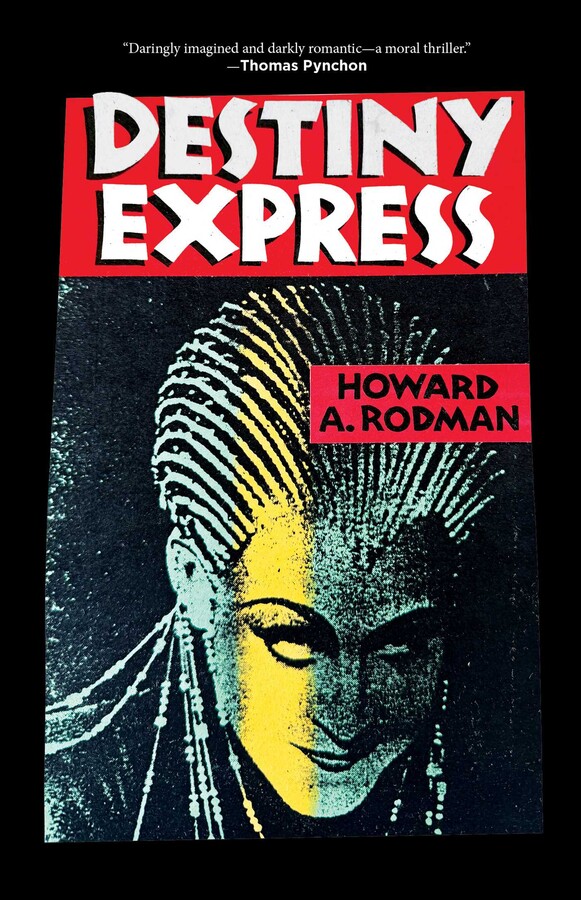
DESTINY EXPRESS
Hailed by Thomas Pynchon as “daringly imagined and darkly romantic—a moral thriller,” DESTINY EXPRESS captures both the glamour and the terror of an era, dramatizing the perilous moment when art, politics, and destiny converged on the tracks out of Berlin.
Berlin, the last day of February, 1933. The Reichstag lies in smoldering ruins, a new world about to spring from its ashes. And now for German filmmakers the choices are stark: stay and collaborate with a government that believes in cinema’s power to shape reality, or leave everything behind. DESTINY EXPRESS is the story of Fritz Lang and Thea von Harbou, husband and wife, director and screenwriter—together, they made some of the greatest films of all time: M, Metropolis, Doctor Mabuse. As each day is torn from the calendar they watch as one by one Bertolt Brecht, Max Ophuls, Billy Wilder, take the next train out. DESTINY EXPRESS follows Lang, von Harbou, and a host of real and fictional others––novelist-turned-minister-of-culture Joseph Goebbels, American café Surrealist Sam Harrison, Mercedes racing champ Otto Merz, film star Rudolf Klein-Rogge, a pair of not-so-secret police—as their paths converge, intertwine, and separate across the grid of Berlin, from the artificial daylight of the UFA soundstage to the artificial night of Berlin’s most exclusive and decadent nightclubs.
Harsh lights, long shadows: the perfect setting for a deeply researched, deftly imagined tale, as one character puts it, of “crime, gambling, cocaine, jazz, stock exchange maneuvers, smuggling, hypnosis, counterfeiting, violence, Expressionism.” DESTINY EXPRESS is the story of a marriage at the end of its passion, at the edge of history—all at the end of an era when film was to mean more than it ever would again.
PRAISE & REVIEWS
“Daringly imagined and darkly romantic—a moral thriller.”
Thomas Pynchon
“What Rodman has done is hard, he’s written an historical novel which is dazzling for its restrained use of history. The painfully accurate sensitivities of Fritz Lang and Thea von Harbou are the real subjects of the book. Sentence by careful sentence, the resonance between what they see and how they see gives Destiny Express a quality of sober reflection that becomes quite beautiful.”
Michael Tolkin
“Remarkable, passionate, inventive…all the words misappropriated on behalf of drivel: they truly belong to this compelling first novel. Not only a fine read, but the emergence of a Writer of Note.”
Harlan Ellison
“Rodman, with his own sharp eye, has written a most original photogenic portrait…”
Samuel Fuller
“The sleek facade of Lang and von Harbou’s marriage is depicted in the novel with the artfulness of one of their exquisitely structured screenplays… Precise, convincing detailing of how it feels to have the ground you walk on give way beneath your feet… Lang’s alarming yearning for his wife and the deep black pool of loss that lies beneath is sparely, deeply poignant.”
Deborah Mason, New York Times Book Review